
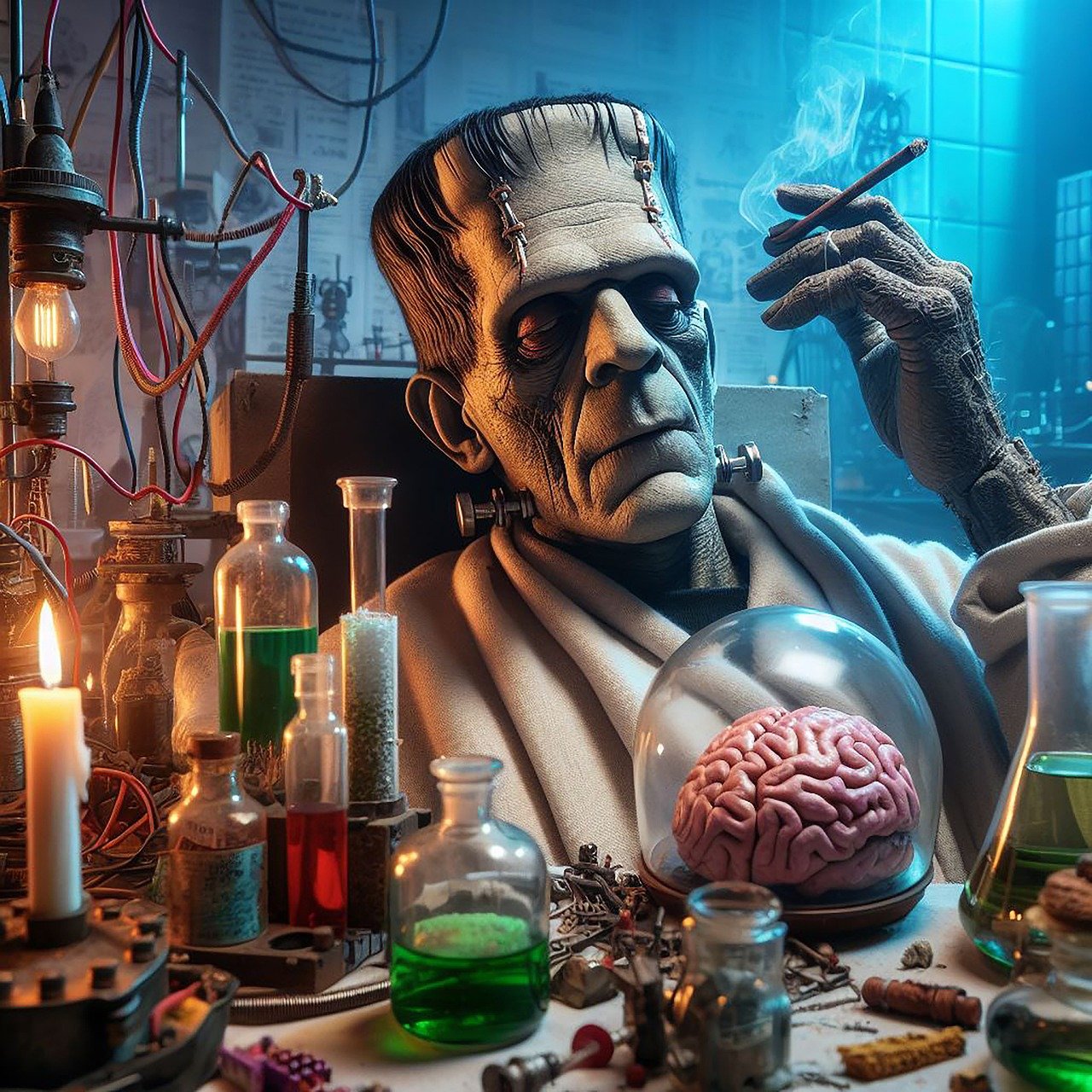
I remember the first time I read Mary Shelley’s Frankenstein. I was in college and we were focusing on female authors – this was back in the mid-1980s, so this approach was interesting. The only exposure I had to Frankenstein was snippets from various black-and-white horror movies. I’m not a big horror fan, so I was not looking forward to reading this book. Was I ever wrong! This is a wonderful and thought-provoking book and I was happy to have it selected over a more typically-for-the-time selection of a book devoted to romantic relationships or society status. I’ve reread this book and it did not disappoint the second time around.
There are several thought-provoking themes in the book, including: the responsibility of parents/creators/others to promote the development of those in our care, the use of technology for immoral or corrupt reasons, the source of evil actions or the nature/nurture debate, and determining the limits and ethical boundaries of scientific discovery. In the book, Victor Frankenstein is a brilliant but irresponsible and callow young man, who works in secret to create a new species that will bring him acclaim and glory. He is the titular Frankenstein, even though movies often refer to his creation (often called his monster) as Frankenstein. He works for two years on building “the creature”, only to be horrified when it comes to life. His creation is ugly – hideous even – which is unacceptable to Victor, who wanted to play God. He abandons his creation and refuses to take responsibility for helping, in some sense, his child learn to survive and find his unique place in a hostile world.
The creation, who is about 8 feet tall and is stronger and faster than humans, is left to fend for himself. He has to find food and shelter as he can. His size and appearance frighten and horrify people, who respond with violence and fear. They drive the Victor’s creation into the forest, where he is at first confused and then angry. He has the capacity for love and tenderness but also extreme violence and vengeance. Yet, in the story, it is the creature who elicits more sympathy, in my opinion. This is where the reader starts asking questions. Is the creature’s behavior due to his nature (e.g., inherent evil) or nurture (e.g., lack of care and compassion and lack of positive social engagement)? Did Victor Frankenstein have a parent’s responsibility to ensure that his creation was able to function in society … or at least on the outskirts of society? In my view, Victor’s creation initally wanted to be loved and accepted, which is why I cannot call him a monster; instead, he was hated, feared, and unprotected.
The creature, who is not given a name, learns to read and speak eloquently, he can think profound thoughts, and is curious about the world. It is conceivable that had he been shown affection from someone, particularly from Victor, that he would never have harmed anyone. Victor’s lack of responsibility throughout the story is frustrating. He is young, brilliant, and beautiful, but it seems that he has no capacity for understanding his creation. He sees only the bad. When his creation expresses him self eloquently, Victor sees it as a way of trying to manipulate others or excuse his actions. When his creation lashes out, Victor sees the violence as unprovoked and directed toward the innocent members of Frankenstein’s family/circle rather than in response to either violence or rejection. On one hand, Victor is correct that his creation is responsible for his actions but his creation has feelings and expectations to lead a peaceful and productive life.
His creation’s loneliness and the violence inflicted upon him drove him to lash out against Frankenstein’s family. He has asked Victor to make him a mate – a female creation so that he would not be alone. If Victor will do this, the two creatures will go away; if not, the creation will destroy Victor’s family. Victor initially agrees to create another creature but also considers that she may not like his male creation or vice versa. He ends up destroying his second creation, which leads to a very violent reaction from his first creation. This is where Victor’s creation loses some of my sympathy – he is wreaking havoc on the lives of innocent, though sometimes thoughtless and careless, people. I certainly have a problem with the creation’s actions that result in or contribute to deaths. He is smart enough to understand that these people they have not wronged him and that they do not deserve to be victims in the war between the creation and his creator.
Victor and his creation chase each other around the world, ending up in the Arctic. Even as Victor was dying, he never acknowledged his responsibility for providing support on the “nurture” side of his creation’s development. The creation was able to acknowledge his remorse of attacking his creator and others. He regretted his actions and his contentious relatioinship with Victor. These regrets lead to him going off into the Arctic cold to die on his own. This is not a simple tale of creating an unintelligent and raging monster who randomly kills people, but rather is a story about what drives an intelligent and peaceable being to become a feared and vengeful monster with the capacity to kill. This is a terrific and compelling story that pushes the reader to contemplate critical questions for some time after the last chapter.
